
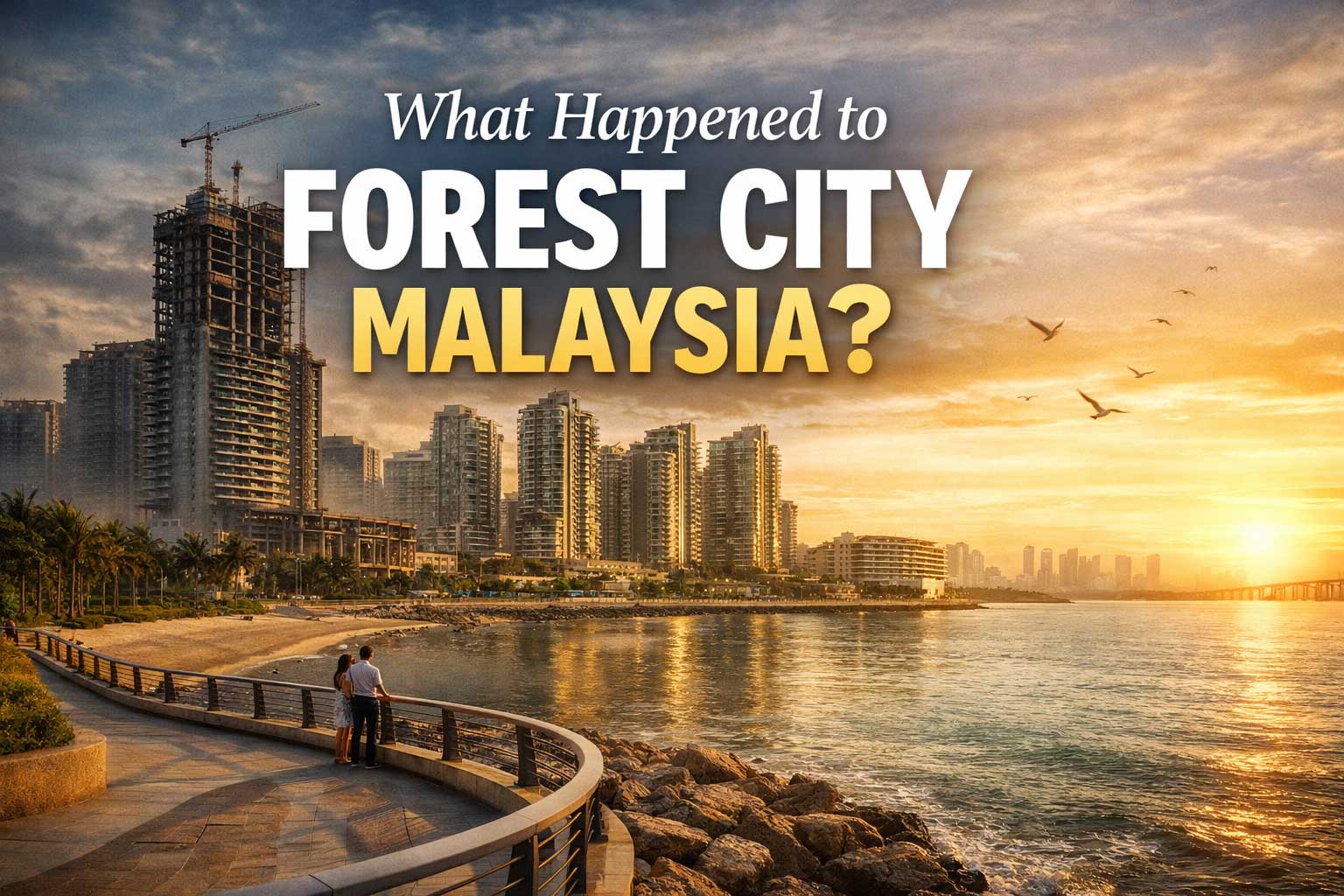
What Happened to Forest City Malaysia?
Forest City Malaysia was once promoted as one of Southeast Asia’s most ambitious real-estate projects—a futuristic, eco-friendly city built on reclaimed islands near Johor and Singapore. Launched with bold promises of luxury living, smart infrastructure, and global investment, it attracted massive attention from international buyers, especially from China.
So why are people now asking: What happened to Forest City Malaysia? Why is Forest City Malaysia abandoned? Why is Forest City Malaysia empty? The short answer: Forest City didn’t “fail”—it stalled. And the reasons are more complex than the “ghost city” headlines suggest.
The Original Vision
Forest City was designed as a:
- Smart eco-city
- Luxury residential hub
- International business and lifestyle destination
- Gateway between Malaysia and Singapore
The master plan envisioned hundreds of thousands of residents, business districts, parks, malls, schools, hospitals, and resorts—all across four man-made islands.
Early marketing targeted foreign investors, especially Chinese buyers, who saw Forest City as a premium overseas property opportunity.
What Went Wrong?
Several major factors disrupted the momentum:
1. Policy Changes on Foreign Ownership
Malaysia introduced stricter rules on foreign property purchases, including:
- Higher minimum purchase prices
- Tighter residency and visa conditions
- Political uncertainty around large foreign-backed developments
This directly reduced the main buyer base Forest City was built for.
2. COVID-19 and Global Slowdown
The pandemic:
- Froze international travel
- Delayed construction and occupancy
- Reduced investor confidence worldwide
Many buyers could not visit, move in, or resell.
3. Over-Ambitious Phasing
Forest City was designed as a mega-project rolled out in stages. But when demand slowed early, large parts of the city were built before population growth could catch up—creating the “empty city” visual effect.
This led to the “abandoned” label, even though:
- Buildings are maintained
- Utilities function
- Residents do live there
- Businesses are operating
It’s not abandoned—it’s under-occupied.
Why Is Forest City Malaysia Empty?
Forest City looks empty because:
- It was built for a future population that has not yet arrived
- International demand paused
- The project’s scale is massive
Think of it like a brand-new airport built for 30 million passengers—but only 3 million arrive in the first years. The infrastructure exists before the crowd.
That visual gap is what created the “ghost city” narrative.
Is Forest City Really Abandoned?
No.
Forest City today has:
- Permanent residents
- Schools and retail areas
- Hotels and serviced apartments
- Operational infrastructure
- Ongoing development
What it lacks is density—not function.
In fact, the Malaysian government has now designated Forest City as a Special Financial Zone (SFZ), offering:
- Tax incentives
- Business-friendly regulations
- Investment support
- Long-term economic repositioning
This marks a new phase: Forest City is shifting from a pure residential vision to a mixed-use economic hub.
How Much Is an Apartment in Forest City Malaysia?
Prices vary depending on unit size, view, and tower, but generally:
| Type of Unit | Approximate Price Range |
|---|---|
| Studio / 1BR | RM 300,000 – RM 450,000 |
| 2BR | RM 450,000 – RM 650,000 |
| 3BR / Premium | RM 650,000 – RM 1M+ |
Compared to Singapore or Kuala Lumpur luxury properties, Forest City offers exceptional value per square meter, especially considering:
- Waterfront location
- New construction
- Resort-style facilities
- Smart-city infrastructure
This pricing gap is exactly why many investors now see Forest City as undervalued rather than failed.
What Really Happened?
Forest City didn’t collapse—it outpaced its time.
It was built for:
- A globalized market
- Free international movement
- High foreign demand
Then the world changed.
Politics shifted. Borders closed. Investment flows slowed.
But the infrastructure remains.
- The land exists.
- The buildings stand.
- The government is reinvesting.
- The vision is evolving.
Forest City is not a dead city. It is a city in reset.
Is Forest City Making a Comeback?
With its Special Financial Zone status, Forest City is now positioned for:
- Business relocation
- Fintech and digital hubs
- Long-term residency growth
- Tourism revival
- Cross-border economic integration
Instead of being a speculative luxury enclave, it is being reshaped into a functional economic zone.
That’s not decline—that’s transformation.
Frequently Asked Questions
What happened to Forest City Malaysia?
Forest City slowed due to policy changes, COVID-19, and reduced foreign demand. It wasn’t abandoned—it was overbuilt for a future that arrived later than expected.
Why is Forest City Malaysia abandoned?
It isn’t abandoned. It is under-occupied. The scale of development makes empty areas visible, but the city is active and maintained.
Why is Forest City Malaysia empty?
Because it was built ahead of population growth. Infrastructure came before residents.
How much is an apartment in Forest City Malaysia?
Apartments typically range from RM 300,000 to RM 1,000,000+, depending on size and location.
Is Forest City still a good investment?
For buyers who understand long-term positioning, Forest City offers rare entry pricing into a master-planned international zone backed by government incentives.
Forest City Malaysia is not a cautionary tale—it’s a lesson in timing.
The city wasn’t built for yesterday.
It was built for a future that is now being rebooted.
